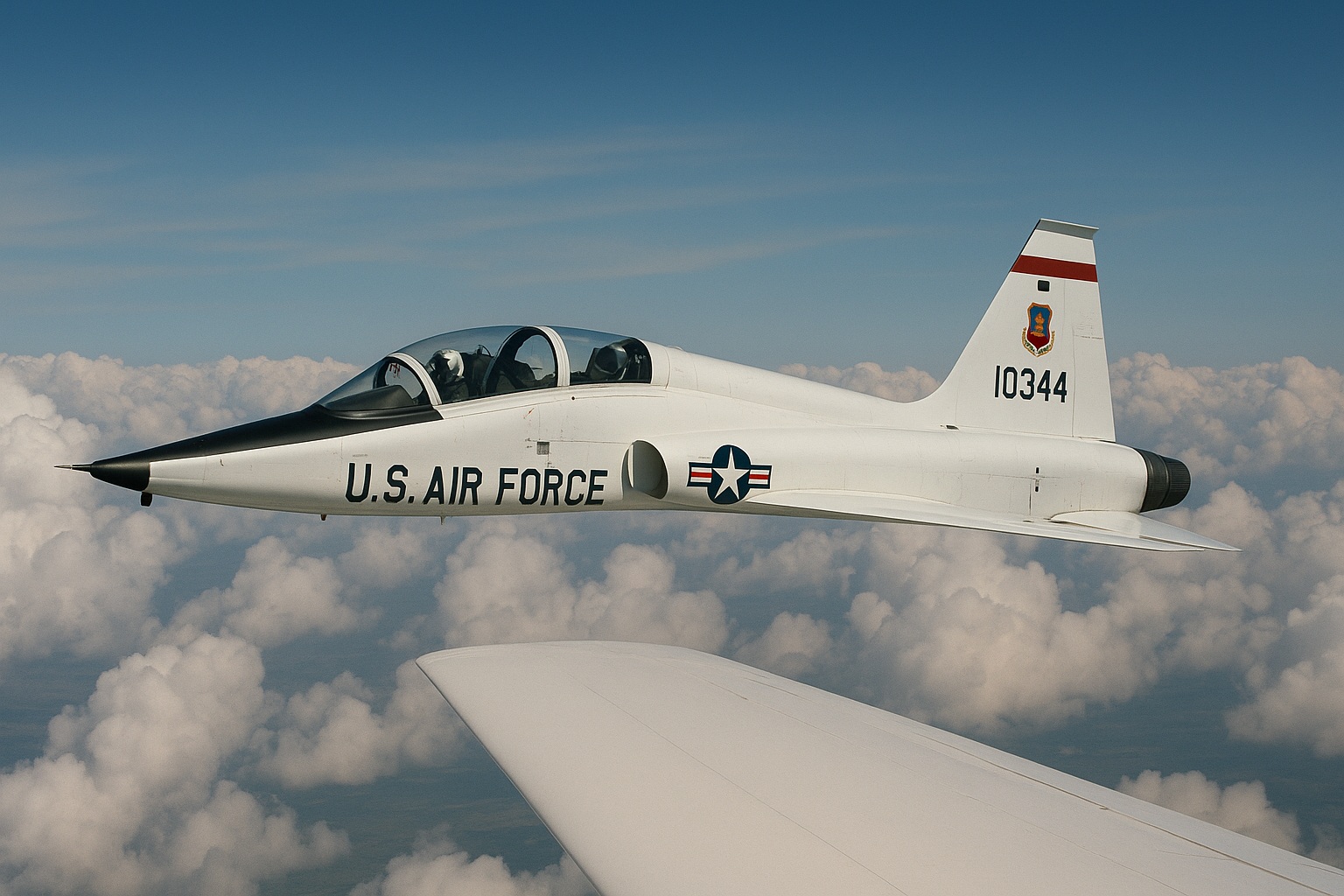
Being an instructor pilot was pretty good work in the Air Force in the early 1970’s. At least it was in the T-38. I was a member of the 25th Flying Training Squadron at Vance Air Force Base, Oklahoma, teaching students to fly the T-38. The Squadron was divided into six Flights, and each Flight had 10-15 instructors. Every six months, our Flight would welcome a class of 20-30 students to take through the T-38 syllabus.
The T-38 is a good, honest trainer. It is supersonic but handles well at landing speeds. It’s uncomplicated for a jet. The plane has very few bad habits and is very forgiving of common student errors. It first flew in 1959 and is still in use for pilot training in 2025. That having been said, it is still a high-performance jet plane from the 1950’s and 1960’s. It deserves the respect the laws of aerodynamics require. But all in all, it is a fun, low-stress plane to fly.
The teaching part was good, too. The “students” were really pilots by the time we met them. They already had about 90 hours in the T-37 jet trainer. They were used to the radio chatter with air traffic control, they had flown solo, and in the T-37, they had done all the maneuvers we would do in the T-38.
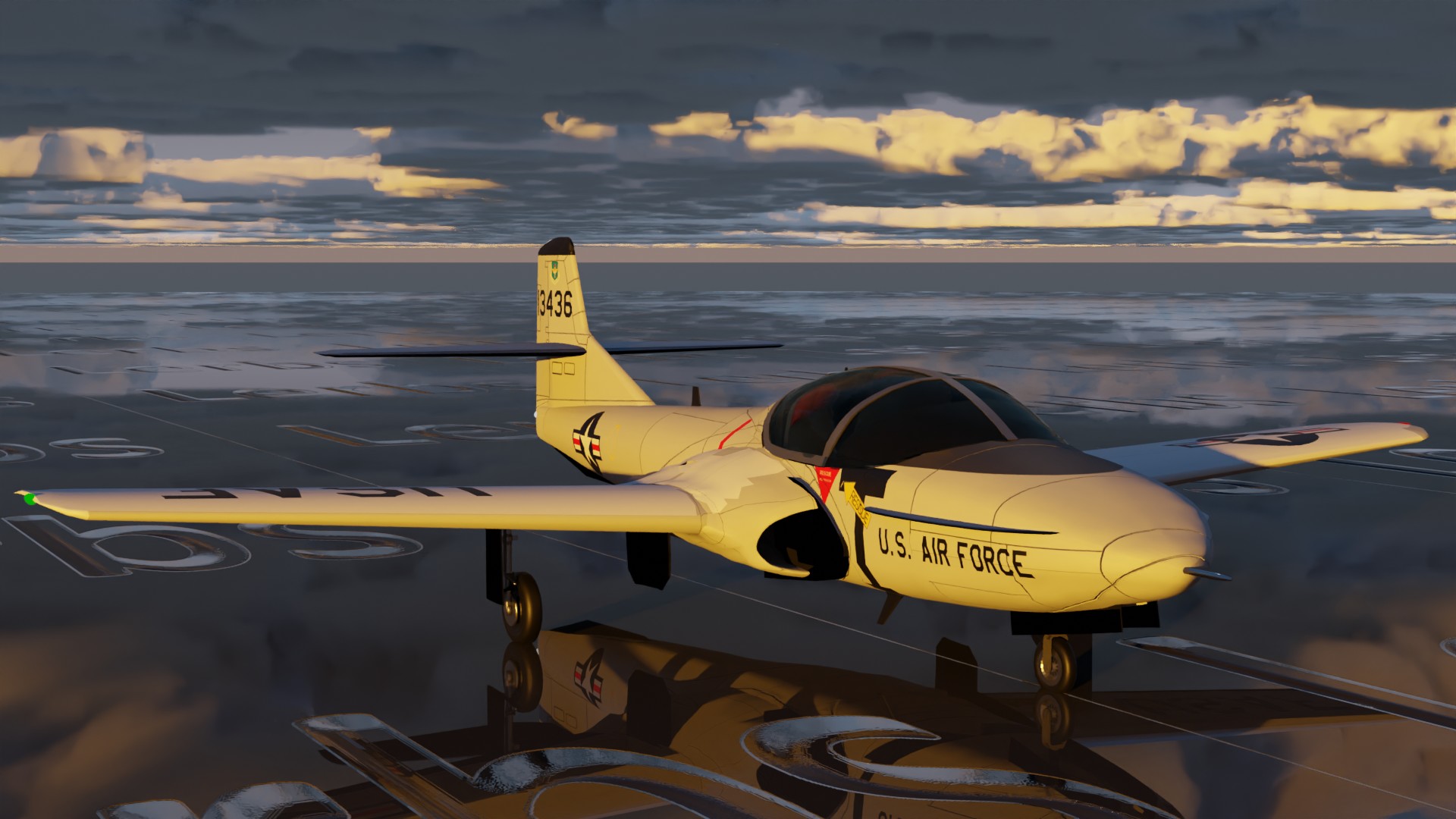
The T-38 course only had a little night flying. But as instructors we had to stay current and proficient at night back seat landings. The easiest way to keep current was as “guest help” for another Flight’s “day/night out-and back.” On those nights, the whole class would take off late one afternoon, land at another airport, eat dinner, and then fly home once it got dark. The return trip was the students’ first time to fly the T-38 at night. It was a dual flight.15 instructors, 20-30 students, that Flight would ask for some extra instructors.
I was about due for night currency, so I signed up.
It was about the easiest flight to instruct. By this mission, the student probably had 50 hours in the T-38 and had flown solo several times. All I had to do was sit in the back seat and watch on the outbound leg, then the same for most of the return. When we got back, I would demo a night landing, then let the student practice a few more. Piece of cake, right?
The Student
When you visit another Flight to instruct one of their students, you expect one of the better students…One they expect to fly well. It’s a lot of paperwork and trouble if he doesn’t perform well, and that’s embarrassing when the instructor is from another Flight. When I went in to meet the guy, he seemed like who I expected. He paid attention during the preflight briefing – good eye contact - and his ground ops were normal.
The Flight Out
Then there was takeoff.
Line up, hold the brakes, run up the engines, check the gauges. All good. Release brakes, light the burners. Love that kick in the pants. Nice smooth rotation, nose up, and lift off. Gear up, flaps up, climbing away from the ground. So far, so good.
In full afterburner, it doesn’t take long to get to 300 knots. It was time to shut down the burners and turn left to the southwest. But he didn’t. Just kept blasting north. In a couple of seconds, we were going like a bat out of Hell. As the instructor, you let students make mistakes as long as it’s safe; that’s how they learn. I didn’t say anything for a while. See what he does. But this guy just kept climbing and accelerating. Air Traffic Control had our flight plan, and we weren’t following it. “Reno 69, say your intentions.” That radio call was for us. Student didn’t answer. Over the intercom, I said, “Did you hear him?” We were really north of course by now, and approaching Mach 1.
The student, “What?”
No time. Me: “I have the aircraft.” I pulled it out of burner, rolled over and pulled us down to our planned altitude. I flew to the planned heading, got the plane slowed down from just below the speed of sound to our planned speed, and gave him back control:
Me: “You have the aircraft”
Student: “I have the aircraft.”
Me: “What was that all about?”
Student: "What was what all about?”
I’m thinking: “Were we in the same airplane?”
He flew just fine for the next 20 minutes. While we were cruising toward Amarillo, I debated with myself.
[Technically, if I have to take control of the aircraft, I should fail him for the flight. But his general flying is OK, and he is more than halfway through the course. Should I overlook that incident? (I could, but I would have to talk to him about it in the debrief and mention it to his Flight commander.) If nothing else goes wrong, I’ll give him a passing grade, but not very high marks.”]
If nothing else goes wrong.
We were cruising along the at 8 miles per minute, so it wasn’t long before it was time to let down into Amarillo. Right on time, he started his let down, flew the instrument approach to a visual pattern, and landed on that huge runway at Amarillo. Beautiful landing. Taxi in to the parking area, shut down. All normal, normal.
While we were eating our vending machine hot dogs and pastries, I decided not to debrief the flight into Amarillo. I was going to have to be a little harsh in my critique of the takeoff and climb, and I didn’t want to make him nervous for the night flight home. First time at night, after all.
The Flight Back
Being nervous turned out not to be the problem.
It got dark, and we went back out to the jet. Preflight, ground ops, taxi out, again, normal, normal.
This time the takeoff and climb were “normal, normal,” and we were soon on course home.
After the letdown (normal, normal again).
I took control and flew the demo night landing to a touch-and-go.
I was happy with my landing. Soft touchdown, on speed in the first 1000 feet. Touch and go procedures: lower the nose a little, advance the power to full without the afterburners, gently raise the nose, let the plane fly away. I gave him control on the downwind.
“See? Do it like that.”
So he did. Right up until he didn’t.
His turn to final was good, but about 15 knots too fast. Now, that’s much better than 15 knots too slow, so no need to say anything.
On final, he was still about 10 knots above final approach speed. Not a big deal.
Alignment and glidepath were good, and he made a smooth touchdown in the first thousand feet. Nice, if still a little fast.
THWOKK!
The student abruptly slammed the control stick against the rear stop. And he held it there. Full aft stick! Both throttles still at idle. The aircraft did as the laws of aerodynamics require. It lifted off the runway, I don’t know how high, but in a deep stall.
As the plane rocked to the right, I had visions of the famous "Sabre Dance" of that F-100 which stalled close to the ground.
The plane started to fall back down. It drifted toward the right edge of the runway because of the right-hand wing rock.
The plane started to fall back down. It drifted toward the right edge of the runway because of the right-hand wing rock.
I just reacted.
I grabbed the control stick and shoved it forward: Break the stall!
I rolled left to level the wings: If I’m going to hit the ground, I’m going to hit with the wheels, not a wingtip.
Slammed both throttles to full afterburner: I need more speed if I want to raise the nose.
The book said it could take 12 seconds for the engines to spin up to 100%, then another two or three for the afterburners to light. I didn’t have fourteen seconds; I didn’t even have five before I hit the ground.
All this time (probably a second, but it felt a lot longer) we were falling, and the edge of the runway was moving closer. We were pointed towards the grass.
The book was wrong. Those burners lit after two or three seconds. And the T-38 is not the F-100.
Just as the burners kicked, the wheels hit the ground. I mean, hit. [Have to report a hard landing.] On concrete. I don’t want to know how close we were to the edge.
The plane bounced up into the air, but with full afterburner, not in a stall, we were flying under control. [Definitely over the grass now.]
Climbing, gear up, flaps up, 280 knots, out of burner.
I climbed up to downwind and let my heartrate slow down.
Student said, “Should I try that again?”
Me: “No, I’ll take this in for a full stop.” [Sit on your hands and never touch the controls again in this lifetime, you extinction level event!]
He did have to touch the controls again. After I landed, taxied back and pulled into parking, he shut the engines down. That can only be done from the front seat.
We went back into the building, sat down for debriefing, and I went through the whole day. I explained that, unfortunately, he had earned a failing grade for the flight. I explained the botched takeoff procedures and missed radio call. I tried to emphasize the danger of stalling a high performance jet close o the ground. The student was calm, almost unconcerned through the whole thing.
Then I asked for his gradebook. I would have some paperwork to do.
He said his flight sommander had the gradebook.
That was strange.The only time the flight commanders take the gradebooks is when the student is on the verge of elimination from the program, down to his last chance.
When I asked the Flight commander for the gradebook, he said, “What the hell were you doing flying with him?”
“Your scheduler put me with him.”
“He is only supposed to fly with me. He’s one failed flight from elimination from pilot training.”
“Well, he had two failed flights today and tonight.”
I never did find out what happened to that student, and I never could figure out why he did what he did.
If it were today, you would tell him to stop texting and fly the plane.
But this was 1975.
Brain cramps.