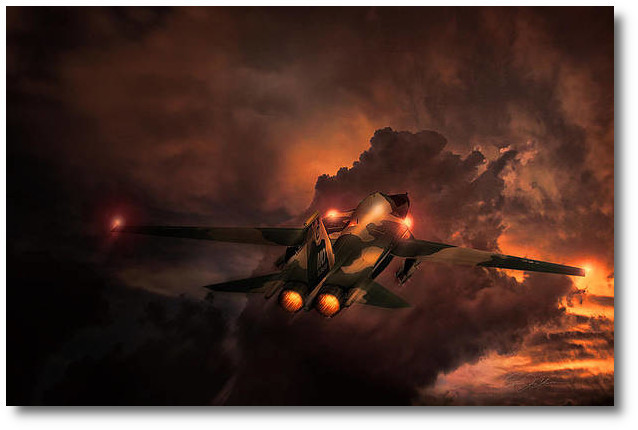
Kids' fairy tales begin with, “Once upon a time…” Fighter stories begin with, “Now, this is No S***”
You can decide how much to believe.
It was (No, it really was!) a dark and foggy night in England. Deepest part of the Cold War. And it was Autumn Exercise Season in Europe, and the Air Force was really set on showing the Army that “all weather” meant ALL WEATHER. The mission was to fly low-level at night--all the way to some Army radar beacon in Germany. Weather on the continent was lousy, so the pilot's name became “Onlyone A. Vailable.” Not many pilots were allowed to do NIGHT LOW ALTITUDE IN THE WEATHER. (Even though NIGHT LOW ALTITIDE IN THE WEATHER was the main reason F-111s were over there.) But this pilot was authorized for it. The schedulers put him with one of the best WSOs (Weapons System Officers) and sent him out.
So off they went, all 80,000 pounds of Aardvark and gas.
They let down into the goo over the North Sea and levelled off at 500 feet radar altitude. It wasn't bad. Kind of like in the simulator: you can't see anything but black out the windscreen, and the sea is flat, so there is no apparent motion. The red beacon flashing off the inside of the cloud is distracting, but you turn it off. (The simulators back in those days weren’t very good.)
They hadn't used much gas at all when they went coast-in over Belgium. Still almost 80,000 pounds all-up weight.
The WSO was good, finding every turn point on the radar, adjusting the timing: "Give me ten more knots for a few miles." They soon crossed the border into northern Germany, down to 200 feet. Every once in a while, the clouds would open enough just to give a brief glimpse of ground lights. Best not to look at those - they look awfully close. Look at the “E-scope” instead. That’s the Terrain Following Radar’s display. It tells the crew their life expectancy for the next minute and a half. Beyond that it could promise nothing. The WSO's radar, though, showed no obstructions for 40 miles. You really depend on that guy and his radar at night; it's his show. From the left seat, still kind of like the sim.
Then, something went, "THUNK!" and a growling noise started. Simulators don't generally go THUNK! and start to growl. It wasn't the pilot's imagination, either, because the WSO looked over and said, "What was that?" Pilot: "Probably just the air conditioner icing up." Even with his mask on, the WSO looked like he didn't buy it, but after a second, he went back to his radar. He said, "take that 10 knots off, we're on time." First clue, when the pilot moved the throttles back, the growl changed. Then, the MASTER CAUTION light came on, plus the right engine OIL QUANTITY light. The right oil quantity dial had gone to zero. A moment later, the right OIL PRESSURE light and zero oil pressure.
Now THAT was a BOLD FACE emergency. Shut down the engine, turn off the bleed air, and get away from the ground! Bring the wings forward, too. If this was in a simulator, it would mean the sim instructor decided to give the crew a tough emergency. It was tough for a couple of reasons.
For one thing, landing the F-111 with an engine out was tricky. Airspeed was important, and you needed to be careful with the power, only half of which was now available. (And this was the “E” model F-111, which had the weakest engines.) Also, they were still heavy, over 75,000 lbs. They weren’t allowed to practice single-engine approaches this heavy. They also weren’t allowed to practice engine-out approaches at night. (That could be dangerous! Best do it for the first time when it’s real.) The emergency procedures recommended getting rid of weight before they attempted to land. They couldn't do that. The old Neandervark could dump fuel pretty fast, but not with the bleed air shut off. And the crew couldn’t fly in circles for an hour to burn down gas. They had to land as soon as they could. So, it was going to be a tricky landing.
The minute the pilot climbed away from the ground, the WSO said, "Zero Two Zero for 18 miles: RAF Gutersloh. (Air conditioner ice, my ass.) " He had already changed the IFF "squawk" to EMERGENCY before the pilot reached for it. Instantly, air defense radar called them by callsign, and said the same thing--"Gutersloh 020 for 18." Radar had tracked them all the way since they let down over the north sea. (So much for sneaking in under the radar.)
The good news: They could be on final approach to a NATO air base in three minutes. More good news: It was a British base and RAF radar controllers were very good. They could talk you down the center stripe on the center of the runway.
That was about it for the good news. Gutersloh was a Harrier base. Harriers landed like helicopters, straight down. They didn't worry about things like arresting cables or wet runways or a little tailwind. Gutersloh had no arresting cables, a wet runway, and a tailwind. And of course, the weather was 200 feet ceiling and a half mile visibility. Light rain.
This is the point in a simulator where you tell the sim instructor, “Come on, man, be realistic. That many things all at once?.” To bad this wasn’t a sim.
Once they got onto final approach, they found another complication. Mil power was not enough to maintain single-engine approach speed. The old Vark just kept slowing down without afterburner. But minimum afterburner was too much. It kept speeding up. Too slow, you get behind the power curve, and you crash short of the runway. But too fast, and you’ll never get the beast stopped before you run off the other end.
The magic number is the calculated “single engine approach speed.” Start five knots above that in mil power. Watch the speed gradually bleed off. At single engine approach speed, select min burner. Hope the burner lights. (It didn’t always.) If it lights, watch the speed build up till you’re five above. Repeat. That night, the burner lit every time.
Meanwhile, you’re still in the murk with nothing but black outside the windscreen. Listen to the controller, make the corrections, and WSO calls out the radar altimeter:. 400, 300, 200 and half a potato, and… there are the lights! Feel the wheels touch, right on centerline, and the most welcome relief.
One more surprise, though. Gutersloh didn’t have “distance remaining” signs by the runway. And the middle of the runway is the top of a hill, so the far end of the runway isn’t visible from touchdown. In fact, it looked like they were rolling fast toward the edge of a cliff. Too heavy and on a wet runway. With a tailwind. Both brakes, full pressure. Let the anti-skid do its thing.
The F-111 came to a stop at the top of the hill with half the runway still in front of it. The pilot had to add power to get to the turn-off. But they made it.
There is a postscript. The crew went to the Gutersloh command post and phoned home: “This airplane is broken, can we have another?”
An RAF corporal came running in, rifle and all, breathless, and announced, “Sir! The American aircraft has exploded!”
No, the F-111 didn’t explode. For some reason, the brakes got hot. Like, really hot (Imagine that!) Let’s see: 75,000 pounds, 140 knots to zero knots in 4000 feet does generate a little heat. The wheels have a heat relief plug which melts to let the air out of the tire if the brakes get too hot. That prevents wheel fires. When the pressure releases, it isn’t quiet.
Everybody went out to look, and there sat the Aardvark, dripping wet, flat left tire and a 15 degree left bank. For posterity, the RAF referred to it as “the F-treble-one that blew its tire when it landed.”
Pilot: “I didn’t blow the tire, I just got the brakes a little hot!”
In the sunlight the next day, RAF maintenance engineers showed the crew the damage. The right engine was completely shelled. Part of the intake had come loose during the low-level flight and been sucked into the engine. You could look in the intake and see out the back. There were no blades left, and that engine was tearing itself apart. The fuselage looked like it had battle damage, and there was a fan blade stuck in a fuselage fuel tank; It had been close.